
In This Article
- 1.
- 2.
- 3.
Too much has been written about grain count in cricket bats.
Yet I felt compelled to write this — not to argue, but to simplify.
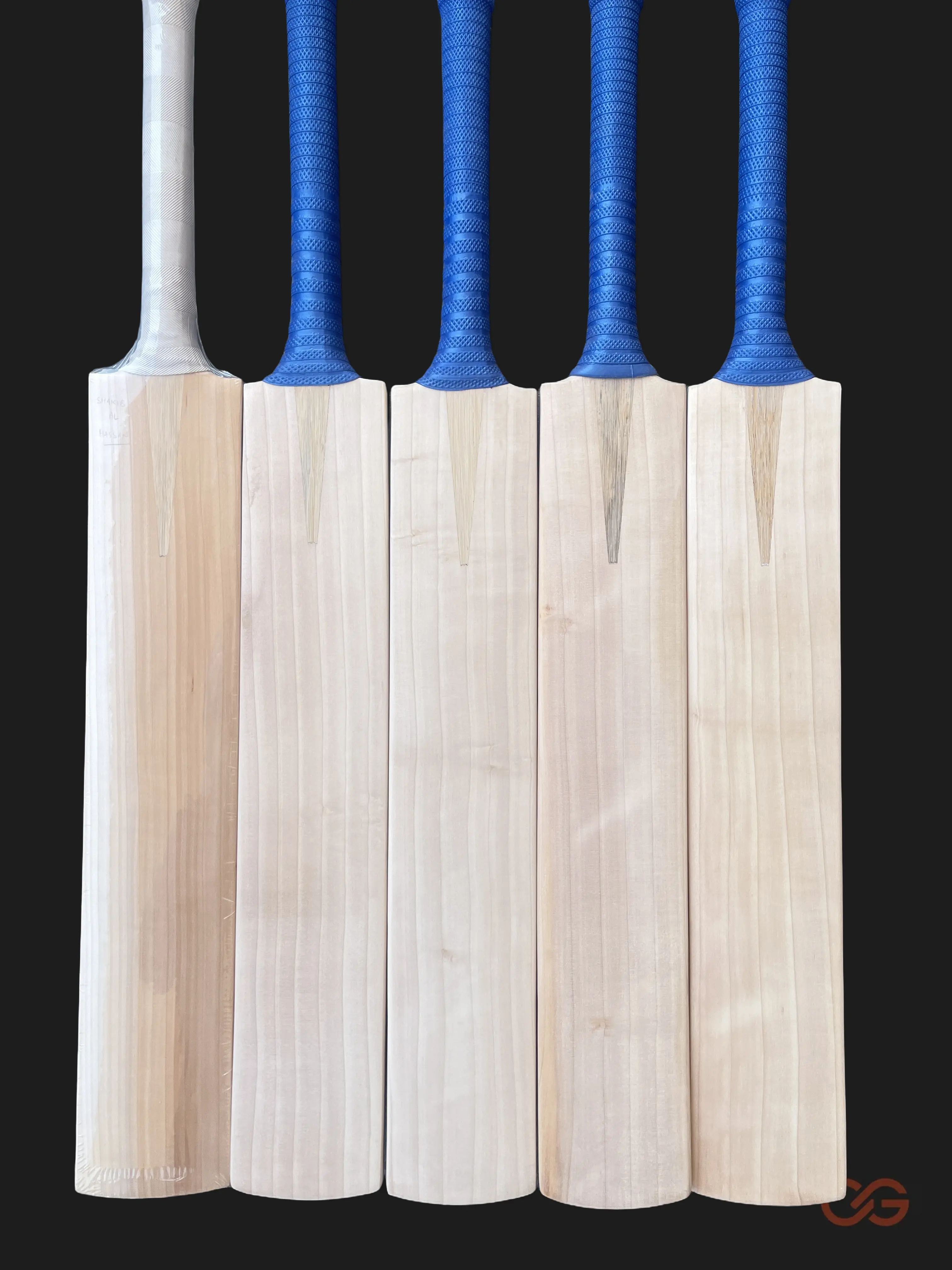
Two bats.
Same feel.
Same weight.
Same price.
One has 5 grains.
The other has 10.
Which one would you pick — and why?
If I’m honest, even today I would feel drawn to the 10-grain bat.
Such is the power of the belief that more grains mean better performance.
A Story Worth Remembering
Once, I handed a Grade 1 English Willow bat to a dear friend — a man who once held the world record for the fastest century in T20 internationals.
He examined the face.
Counted the grains.
Paused.
“This is not Grade 1,” he said. “It has only 7 grains.”
I didn’t argue.
He knocked it.
The sound told a different story.
Months later, that bat became his match bat.
He is not alone. Many elite players have used bats with 5–6 grains. Grain count did not define their performance.
So What Are Grains?
Grains are simply growth rings — the marks left by how much the tree grew each year.
They influence appearance.
They do not directly measure rebound, balance, density distribution, or pressing quality.
Grain count is a visual classification.
Performance is structural behaviour.
What Actually Affects Performance
From a materials perspective, three factors matter far more than the number of visible grains:
1. Density & Internal Structure
The way the fibres are arranged and how dense the willow is determines how it compresses and rebounds on impact.
2. Moisture & Conditioning
Too dry, and the bat becomes brittle.
Too moist, and it feels dull.
Proper conditioning keeps the bat responsive and durable.
3. Pressing & Preparation
How the cleft is pressed and how the bat is prepared influences hardness, ping, and durability more than the grain count printed on a sticker.
A well-prepared 5-grain bat can outperform a poorly prepared 10-grain bat.
A 10-grain cleft can have inferior internal density compared to a 5-grain one.
Don’t pay for looks if performance feels the same.
If grain count isn’t the real driver of performance, why does it influence us so strongly?
Why We Trust What We See
We are drawn to visible signals.
Grain count is visible.
Density is not.
Pressing depth is not.
Moisture balance is not.
So we trust what we can count.
This is not ignorance.
It is human wiring.
Visible cues feel safer.
They give us something to measure.
But improvement begins when we slow that instinct down.
In bats, performance depends on structure.
In life, it is often the same.
We tend to reward what looks impressive —
a high grain count, a higher price tag, a label.
But the foundations are usually invisible.
The discipline is not in choosing the 5-grain bat.
The discipline is in learning to choose based on what works — not what looks impressive.
Before You Choose Your Next Bat, Remember This
1. Look for straight, even grain — not just a higher number.
Straight, continuous grain lines matter more than how many there are. Consistency across the face tells you more than an impressive count.
2. Inspect the bat as a whole, not just its face.
Clean edges, balanced pickup, a smooth profile, and a straight spine influence feel and durability more than the number printed on the label.
3. Trust preparation and feel over marketing labels.
A bat that responds well during knocking-in and produces a controlled, crisp ping in the sweet spot will serve you better than one chosen for its grain count alone.
Most of us don’t buy bats with our hands.
We buy them with our eyes.
The next time you walk into a store, pause for a moment.
Will you choose what looks impressive —
or what plays best in your hands?